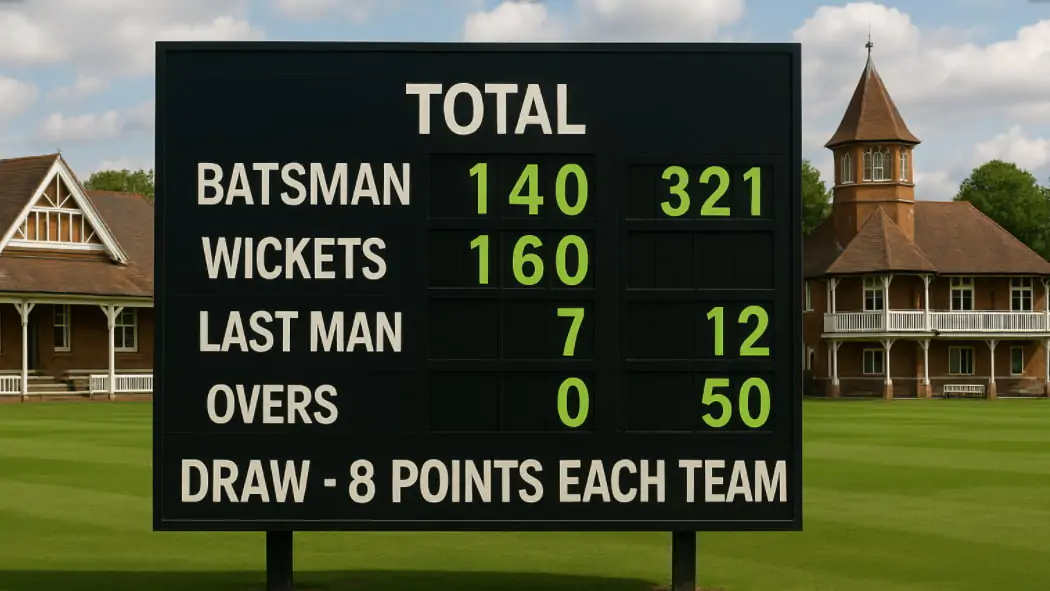
County cricket’s points system forms the backbone of the Vitality County Championship, determining which teams claim promotion, relegation, or championship glory. In the current ECB scoring system, each team receives 8 points for a draw, making these outcomes valuable for accumulating points throughout the season. This system rewards competitive cricket while ensuring that teams can still benefit from strong performances even when matches don’t reach a definitive conclusion. Additionally, teams can earn bonus points from their first innings performance, making every aspect of county cricket strategically important for the overall championship standings.
Current County Championship Points System
The England and Wales Cricket Board (ECB) operates a structured points system that governs all County Championship matches. When matches end in a draw, both teams receive exactly 8 points each, which represents half the points awarded for an outright victory.
This balanced approach ensures that drawn matches still contribute meaningfully to a team’s season total. Meanwhile, winning teams earn 16 points, creating a clear incentive for aggressive cricket while maintaining fairness for competitive draws.
The county championship draw points system treats both teams equally when matches cannot reach a conclusion within the allocated playing time. This equality reflects cricket’s traditional values of fair play and recognizes that weather, pitch conditions, or tactical batting can legitimately prevent decisive results.
Points Breakdown by Match Result
| Match Result | Points Awarded | Additional Notes |
|---|---|---|
| Win | 16 points | To winning team only |
| Draw | 8 points | To both teams |
| Tie | 8 points | To both teams |
| Loss | 0 points | No points for losing team |
| No Result | 5 points | To both teams if insufficient play |
Beyond the basic match result points, teams can earn valuable bonus points based on their first innings performance. These additional points often prove crucial in tight championship races and relegation battles.
Bowling teams earn one point for each two wickets taken in their opponents’ first innings, up to a maximum of five bonus points. Similarly, batting teams can earn bonus points for reaching certain run thresholds, with points awarded at 200, 250, 300, 350, and 400 runs.
County Cricket Scoring System 2025 Structure
The current scoring framework has remained consistent for several years, providing stability and predictability for teams planning their seasonal strategies. Teams competing in Division One and Division Two follow identical scoring rules, ensuring fairness across both tiers of the competition.
This consistency allows players, coaches, and supporters to easily track championship progress throughout the season. Moreover, the ECB county championship points rules apply uniformly across all 18 first-class counties, from established teams like Yorkshire and Surrey to newer additions like Durham.
Weather interruptions frequently affect county cricket, making the draw points system particularly relevant during the traditional English summer. Rain-affected matches often result in draws, meaning teams must balance aggressive tactics with the security of earning guaranteed points.
First Innings Bonus Points System
Understanding bonus points becomes crucial when analyzing how teams accumulate points throughout a county cricket season. The first innings points county cricket system rewards both batting and bowling excellence, encouraging positive cricket from the opening session.
Batting bonus points operate on a sliding scale, with teams earning their first point upon reaching 200 runs. Additional points follow at 50-run intervals until reaching the maximum of five bonus points at 400 runs or more.
Bowling bonus points mirror this structure, with teams earning points for every two wickets taken. This system ensures that strong bowling performances receive recognition even when batsmen score heavily on flat pitches.
Consequently, even in drawn matches, teams can earn between 8-13 total points depending on their first innings performance. This range makes bonus points particularly valuable for teams fighting for championship positions or avoiding relegation.
Bonus Points in the First Innings
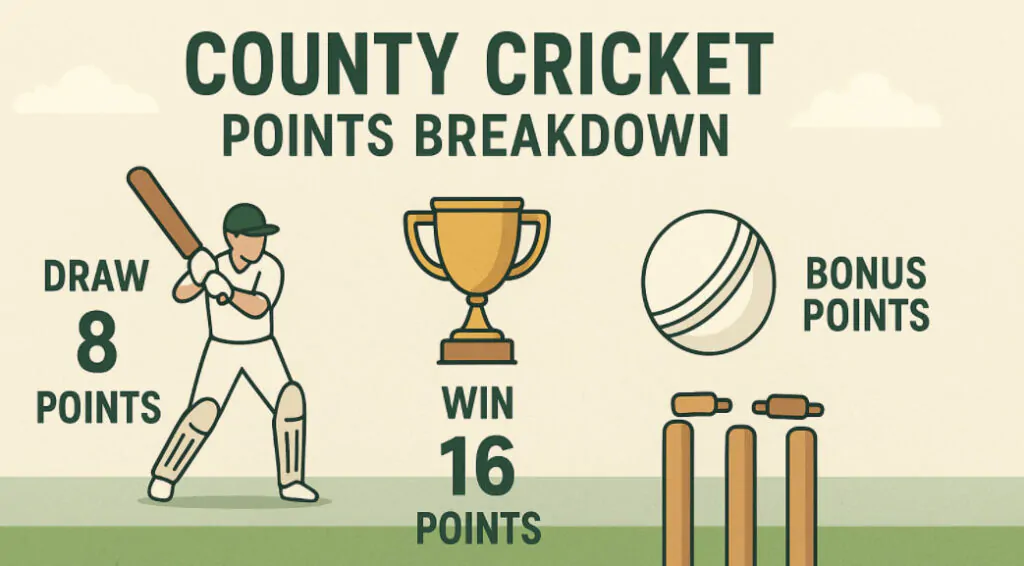
Bonus points are available in the first 110 overs of each side first innings. Batting points scale with runs and bowling points scale with wickets.
| Bonus type | Thresholds within first 110 overs | Points available |
|---|---|---|
| Batting | 250 runs gives 1 point | 1 |
| 300 runs gives 2 points | 2 | |
| 350 runs gives 3 points | 3 | |
| 400 runs gives 4 points | 4 | |
| 450 runs gives 5 points | 5 | |
| Bowling | 3 wickets gives 1 point | 1 |
| 6 wickets gives 2 points | 2 | |
| 9 wickets gives 3 points | 3 |
These bonus points are added to the match result points. If a match is drawn, both teams still receive any bonus points that were earned in the first innings.
Why Draw Points Matter for Tactics
Draw points set the baseline for a safety net while bonus points push teams to play briskly on day one and early day two. Captains weigh declarations to chase a win without giving away easy runs. Batting sides may speed up once a threshold is reached, while fielding sides hunt early wickets to bank bowling points before the 110 over cut off. This balance makes the middle of the match just as interesting as the final session.
Worked Examples for Common Scenarios
| Scenario | Team A points | Team B points |
|---|---|---|
| Draw with A 350 runs and 8 wickets taken, B 300 runs and 7 wickets taken | A gets 8 result plus 3 batting plus 2 bowling for 13 total | B gets 8 result plus 2 batting plus 2 bowling for 12 total |
| Tie with A 420 runs and 9 wickets taken, B 455 runs and 6 wickets taken | A gets 8 result plus 4 batting plus 3 bowling for 15 total | B gets 8 result plus 5 batting plus 2 bowling for 15 total |
| Win for A with 280 runs and 9 wickets taken, B 240 runs and 5 wickets taken | A gets 16 result plus 2 batting plus 3 bowling for 21 total | B gets 0 result plus 0 batting plus 1 bowling for 1 total |
These are simple examples. Real matches can include penalties or special cases in the competition rules, so teams always check the current playing conditions.
Historical Context of County Cricket Points
The county cricket points system has evolved considerably since the Championship’s inception in 1890. Early championships relied purely on win-loss records, with no points awarded for draws or bonus achievements.
However, modern county cricket recognizes that drawn matches can contain exceptional cricket worthy of reward. The current 8-point allocation for draws represents a compromise between encouraging positive cricket and acknowledging competitive balance.
Etymology theories suggest that the term “draw” in cricket derives from the concept of “drawing stumps” at the end of play, though cricket historians acknowledge uncertainty about definitive origins. Alternative theories propose connections to the military term meaning a tactical withdrawal without decisive outcome.
The county cricket bonus points system was introduced to reward first innings performance, addressing concerns that teams might adopt overly defensive approaches knowing they could earn draw points regardless of their cricket quality.
Impact on Championship Standings
Draw points significantly influence championship calculations, particularly in close seasons where promotion and relegation hang in the balance. Teams can secure championship titles or avoid relegation through accumulated draw points combined with strategic bonus point collection.
The mathematics of county cricket championships often revolve around these 8-point allocations, especially when several teams compete closely for final positions. Smart teams focus on consistent point accumulation rather than purely pursuing victories that might result in costly defeats.
Recent championship seasons have demonstrated how draw points can determine final standings, with teams separated by margins smaller than a single match victory. This reality makes every drawn match valuable for maintaining competitive positioning throughout the season.
Furthermore, the county championship points table calculation includes bonus points, meaning teams can potentially earn more from a drawn match (13 points maximum) than opponents earn from some victories without bonus points.
Weather and Draw Frequency
English weather patterns directly impact the frequency of drawn matches in county cricket, making the 8-point allocation particularly relevant during wet seasons. Traditionally, April, May, and September matches experience higher draw rates due to weather interruptions and challenging playing conditions.
Teams must factor weather probabilities into their seasonal planning, recognizing that draw points might form a substantial portion of their total accumulation. Consequently, maximizing first innings performance becomes crucial for teams seeking to optimize their points return from potentially drawn matches.
Modern county cricket scheduling attempts to minimize weather disruption, but the sport’s outdoor nature makes draw scenarios inevitable. Teams that excel at securing bonus points while ensuring draw points often outperform those focusing solely on victory or defeat outcomes.
Practical Tips for Fans and New Followers
- Check the live score with attention to the first 110 over mark in each first innings
- Track batting runs toward the next threshold to predict table impact
- Watch bowling changes near a wicket threshold to see captains push for points
- Look at the table on Monday morning with bonus tallies in mind, not just wins and losses
These habits make a county weekend feel richer and help explain why teams take calculated risks late on day four.
Frequently Asked Questions
How many points do both teams get for a draw in county cricket?
Both teams receive exactly 8 points for a draw in the County Championship. This applies whether the match is genuinely drawn or declared a draw due to weather or time constraints.
Can teams earn more than 8 points in a drawn match?
Yes, teams can earn up to 13 points total in a drawn match by combining the 8 draw points with 5 bonus points from their first innings performance. This makes first innings cricket strategically crucial even in drawn games.
What’s the difference between draw points and tie points in county cricket?
There is no difference in the current system. Both draws and ties result in 8 points for each team, treating these outcomes equally in the championship standings.
Do weather-affected matches always result in draw points?
Weather-affected matches typically result in draws earning 8 points each, unless insufficient play occurs to constitute a proper match. In cases of minimal play, both teams might receive 5 points for a “no result.”
How do draw points affect promotion and relegation battles?
Draw points can be crucial in close championship races. Teams can secure promotion or avoid relegation through consistent accumulation of draw points combined with bonus points, even without winning the majority of their matches.
When were the current county cricket draw points introduced?
The current 8-point system for draws has been stable for several years, though the County Championship points system has evolved throughout its history. The ECB maintains this structure to balance competitive cricket with fair point distribution.
References:
- ECB: How does the Vitality County Championship scoring system work?: https://www.ecb.co.uk/news/846404/how-does-the-county-championship-scoring-system-work
- Cricket Resolved: County Championship Format, Points System, and Teams: https://cricketresolved.com/county-championship-format/
- London Mirror: County Championship Points System: https://londonmirror.co.uk/county-championship-points-system/
Article Summary
A draw in the Vitality County Championship is worth eight points, with first innings bonus points added on. Wins bring sixteen points, ties also carry eight, and bonus points reward runs and wickets within the first 110 overs of each side first innings. These rules shape declarations and day one tempo, so following the bonus thresholds makes the league table easier to read.