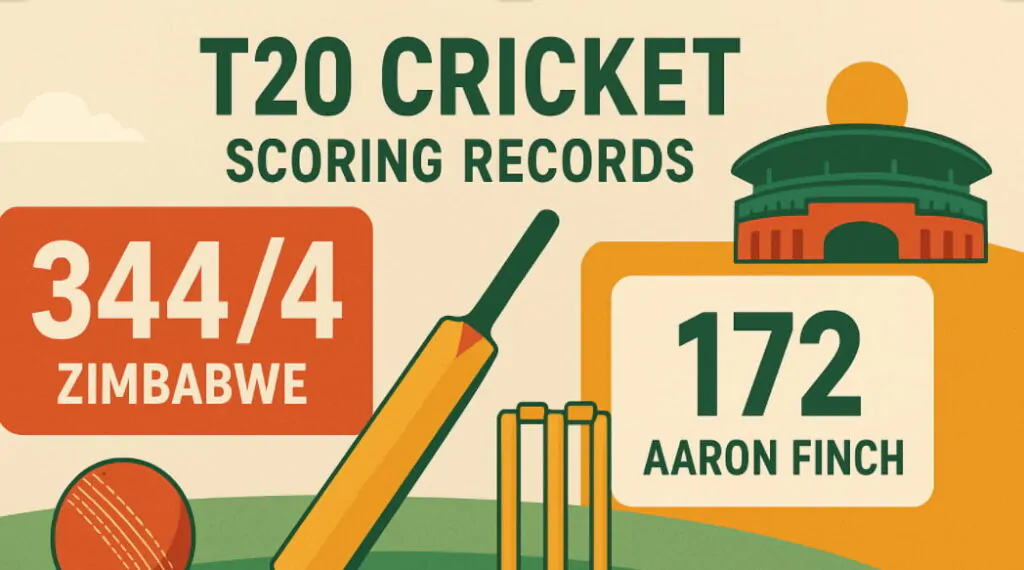
Cricket’s shortest format continues to produce extraordinary scoring feats that redefine what’s possible in just 20 overs. Zimbabwe holds the record for the highest T20 score in history with their stunning 344/4 against Gambia in October 2024, breaking multiple records in a single innings. This incredible total surpassed all previous benchmarks and showcased the explosive nature of modern T20 cricket. The match, played during the T20 World Cup Africa sub-regional qualifier, demonstrated how smaller cricket nations can produce world-beating performances when conditions align perfectly.
Current T20 Scoring Records Breakdown
Cricket’s record books received a complete overhaul in 2024 when multiple scoring milestones fell within months of each other. Zimbabwe’s 344/4 against Gambia represents the pinnacle of T20 scoring, achieved during international competition where pressure and stakes were highest.
This extraordinary total came courtesy of Sikandar Raza’s unbeaten 133 off just 43 balls, an innings that included boundaries flowing from every corner of the ground. Meanwhile, his teammates contributed valuable runs around him, creating the perfect storm of aggressive batting and favorable conditions.
The previous record belonged to domestic cricket, where scoring records often benefit from familiar conditions and potentially weaker bowling attacks. However, Zimbabwe’s achievement in international cricket adds extra credibility to their record-breaking performance.
Highest Individual T20 Score Cricket Records
While team totals capture headlines, individual brilliance often provides the foundation for record-breaking innings. Aaron Finch’s 172 not out for Australia against Zimbabwe in 2018 remains the highest individual score in T20 internationals, demonstrating sustained excellence across an entire innings.
Finch’s remarkable knock came during a bilateral series in Zimbabwe, where he dismantled the bowling attack with clinical precision. His innings included 16 fours and 10 sixes, showcasing the full range of modern batting techniques.
Other notable individual performances include Chris Gayle’s 175 not out in the IPL and various domestic cricket achievements. However, these scores came in different competitive environments, each presenting unique challenges and opportunities for batsmen.
Subsequently, Sikandar Raza’s 133 not out during Zimbabwe’s record total adds another chapter to T20’s greatest individual performances. His strike rate of over 300 during this innings exemplified the aggressive approach necessary for such extraordinary totals.
Team Total Records Across Formats
| Competition Level | Highest Score | Team | Opposition | Year |
|---|---|---|---|---|
| T20 International | 344/4 | Zimbabwe | Gambia | 2024 |
| Domestic T20 | 349/5 | Baroda | Sikkim | 2024 |
| IPL | 263/5 | Royal Challengers Bangalore | Pune Warriors | 2013 |
| Big Bash League | 232/5 | Melbourne Stars | West Indies | 2019 |
Different cricket formats and competitions have produced varying record totals, reflecting the quality of bowling attacks and playing conditions. International cricket traditionally features stronger bowling lineups, making Zimbabwe’s achievement even more impressive.
Domestic competitions often see higher scores due to varying skill levels between teams, though Baroda’s 349/5 against Sikkim in the Syed Mushtaq Ali Trophy represents exceptional hitting regardless of opposition quality. This total came just months before Zimbabwe’s international record, suggesting T20 batting standards continue evolving rapidly.
Nevertheless, comparing records across different levels requires acknowledging the varying competitive standards and external factors that influence scoring opportunities.
Another Snapshot of How the Top Totals were Built
| Score | Key batting features | Boundary pattern | Notable phase |
|---|---|---|---|
| 344 4 | Multiple top order half centuries at strike rates above 200 | High six count through mid overs | Powerplay start then acceleration again overs 13 to 18 |
| 314 3 | Rapid fifty by Dipendra Singh Airee fastest fifty in same match nepal airee reference | Cluster of sixes in final two overs | Late surge turned a big score into a record |
| 278 3 | Anchor innings plus two finishers | More fours than sixes compared with newer records | Consistent ten plus per over from start |
| 278 4 | Top order all contributed quick cameos | Balanced fours and sixes mix | Used fielding lapses to maintain tempo |
| 273 2 | One century plus strong support | High percentage boundaries in first ten overs | Early platform allowed low risk finish |
These patterns show that modern record attempts rarely rely on a single hitter alone. Instead structure and pacing through powerplay middle overs and death overs combine.
Evolution of T20 Scoring
T20 cricket’s scoring evolution reflects changing techniques, equipment improvements, and tactical innovations since the format’s inception in 2003. Early T20 matches rarely saw totals exceeding 200, with teams still learning optimal strategies for the condensed format.
Modern T20 cricket has transformed completely, with scores above 200 becoming increasingly common in professional leagues worldwide. Batsmen now approach the format with specialized techniques designed specifically for maximum scoring in limited overs.
Equipment improvements, including lighter bats with larger sweet spots, have contributed to the scoring explosion alongside rule changes favoring attacking cricket. Additionally, smaller grounds and flatter pitches in some venues create ideal conditions for record-breaking performances.
The T20 cricket scoring records 2024 demonstrate this evolution’s acceleration, with multiple long-standing records falling within a single year. This trend suggests even higher totals may become achievable as the format continues developing.
Factors Behind Record-Breaking Scores
Several elements must align perfectly for teams to achieve record-breaking totals in T20 cricket. Pitch conditions play a crucial role, with flat surfaces and short boundaries creating ideal environments for aggressive batting.
Weather conditions also significantly impact scoring potential, with clear skies and minimal wind allowing batsmen to target boundaries with greater confidence. Additionally, the quality of opposition bowling affects scoring opportunities, though even weak attacks require execution to achieve record totals.
Team strategy and batting order optimization have become increasingly sophisticated, with teams now planning specifically for maximum scoring rather than simply winning matches. This approach requires accepting higher risk in pursuit of extraordinary totals.
Furthermore, individual form and confidence levels often determine whether batsmen can capitalize on favorable conditions. The mental aspect of attempting record scores adds pressure that only exceptional players can handle effectively.
Zimbabwe Highest T20 International Score Impact
Zimbabwe’s record-breaking performance against Gambia created ripple effects throughout international cricket, proving that any team can produce extraordinary performances under the right circumstances. This achievement boosted Zimbabwe cricket’s profile significantly while inspiring other associate nations.
The match highlighted T20 cricket’s unpredictable nature, where form guides and rankings become irrelevant when conditions favor aggressive batting. Zimbabwe’s success demonstrated that preparation, execution, and favorable circumstances can overcome traditional strength disparities.
International cricket boards took notice of this performance, recognizing that T20’s global growth requires supporting all nations’ development programs. Zimbabwe’s record serves as evidence that cricket’s democratizing potential through the shortest format.
Moreover, this performance influenced selection policies and strategic approaches across associate cricket nations, showing what becomes possible with proper planning and execution.
Etymology and Format Development
The term “Twenty20” originally described the format’s structure of 20 overs per team, though cricket historians suggest multiple theories about who first coined this specific terminology. Some sources attribute the naming to the England and Wales Cricket Board’s marketing department, while others propose it evolved naturally from cricket commentary.
Alternative theories suggest the name derives from the mathematical simplicity of 20 overs providing a neat timeframe for television broadcasts. However, definitive documentation about the format’s naming remains limited, requiring caution when discussing specific etymological claims.
The format itself developed from earlier limited-overs experiments, building on successful innovations in One Day International cricket. T20’s creators aimed to condense cricket’s excitement into an evening’s entertainment, fundamentally changing how the sport approaches scoring and strategy.
Consequently, the format’s evolution continues influencing traditional cricket forms, with Test and ODI cricket adopting more aggressive approaches inspired by T20 innovations.
Impact on Modern Cricket Strategy
Record-breaking T20 scores have revolutionized cricket strategy across all formats, encouraging more aggressive approaches even in longer forms of the game. Teams now prioritize boundary-hitting ability when selecting players, fundamentally changing traditional cricket skills emphasis.
Bowling strategies have evolved in response to increased scoring rates, with death bowling becoming a specialized skill requiring specific techniques and mental strength. Field placements and captaincy decisions now factor in the possibility of extraordinary scoring rates.
Additionally, cricket coaching has adapted to emphasize power-hitting techniques and innovative shot selection. Training methods now include specific preparation for high-pressure scoring situations that were previously rare in cricket.
These changes reflect T20’s broader influence on cricket culture, where entertainment value and scoring excitement have become primary considerations alongside traditional competition elements.
Frequently Asked Questions
What is the highest T20 score ever recorded?
Zimbabwe holds the record with 344/4 against Gambia in October 2024 during the T20 World Cup Africa sub-regional qualifier. This surpassed all previous records in both domestic and international T20 cricket.
Who scored the highest individual T20 score?
Aaron Finch holds the record for the highest individual T20I score with 172 not out against Zimbabwe in 2018. In domestic T20 cricket, Chris Gayle scored 175 not out in the IPL, though this remains outside international cricket.
When did Zimbabwe set the T20 scoring record?
Zimbabwe achieved their record-breaking 344/4 on October 23, 2024, during their T20 World Cup Africa sub-regional qualifier match against Gambia in Nairobi, Kenya.
What was the previous highest T20 team total?
Before Zimbabwe’s record, the highest T20 total was 314/3 by Czech Republic against Turkey in 2019. However, Baroda’s 349/5 against Sikkim in domestic cricket had also surpassed this mark earlier in 2024.
How many sixes were hit in Zimbabwe’s record innings?
Zimbabwe’s innings featured numerous boundaries, with Sikandar Raza’s 133 not out including multiple sixes off just 43 balls. The exact boundary count contributed to their record-breaking total of 344 runs.
Can T20 scores go even higher than 344?
Theoretically, T20 scores could exceed 344 if conditions align perfectly with exceptional batting performances. The format’s evolution suggests even higher totals may become possible as techniques and equipment continue improving.
References:
- ESPNCricinfo: Zimbabwe’s 344 for 4 breaks the record for highest T20 total: https://www.espncricinfo.com/series/men-s-t20-world-cup-sub-regional-africa-qlf-b-2024-25-1453889/gambia-vs-zimbabwe-12th-match-1453932/match-report
- Cricket.com: Zimbabwe post highest total in T20 history: https://www.cricket.com/news/zimbabwe-post-the-highest-total-in-t20-history-obliterate-records-10232024-1729687495333
- The Cricket Panda: Highest T20 Score Of All Time (Updated 2025): https://www.thecricketpanda.com/highest-t20-score/
Article Summary
Zimbabwe 344 for 4 vs Gambia stands as the current highest T20 team score worldwide surpassing Nepal 314 for 3 vs Mongolia. Rising run rates reflect tactical evolution deeper batting and fielding restrictions used with skill. Linguistic roots of cricket innings and powerplay show gradual adoption rather than single origin certainty. Future records may rely on favourable conditions and expanding tactical sophistication across full member and associate levels.